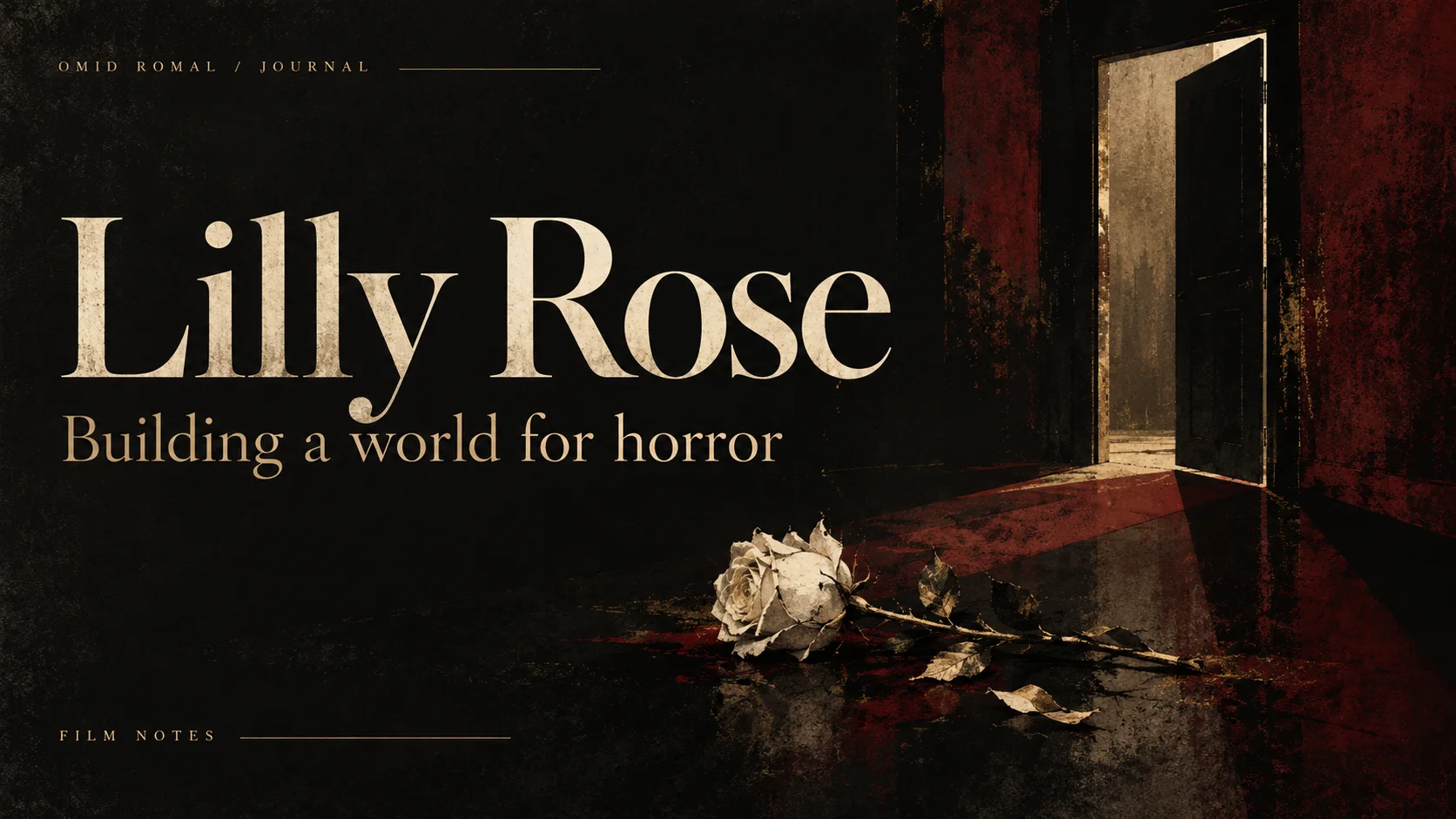
Project timeline: 14 October 2025 · interview milestone. Published as a retrospective on 23 October 2026.
With Lilly Rose, I am drawn to the challenge of giving a performer a world that can feel beautiful and threatening at the same time. Tia Bajpai named me as the director of Lilly Rose – Chapter 1 in her Free Press Journal interview. It is a collaboration that lets me think about horror through atmosphere, character and uncertainty.
The credits place my direction alongside Arian Romal’s writing and music. I want those contributions to meet with a clear purpose. A frightening setting can create an immediate impression, but the audience still needs someone to stay with inside it. For me, the character’s relationship to the world is where the film starts to become interesting.
What the project asks of me
A frightening image may last a moment. The expectation around it can last much longer. I want the direction to take that difference seriously. If every scene announces its danger in the same way, the audience learns the pattern too quickly. Suspense needs variation in what is shown, what is withheld and when a question is answered.
That thinking applies to performance as much as to a setting. A character needs something to respond to, even when the audience cannot yet identify the source of the unease. I am interested in small changes in certainty: a person entering confidently, noticing something and beginning to move through the same space differently.
An international production also brings together people with different experiences of filmmaking. I want that exchange to serve the scene rather than become a collection of assumptions about how someone else works. Clear preparation and a shared understanding of the story help give an actor room to contribute.
The published credits identify Arian Romal as writer and composer, with my role in direction. Those are separate disciplines within the same project. A horror film depends on how they meet: what the story asks, what the performer carries and how image and sound shape the audience's experience.
I am careful when looking back at announcements around a film. A date mentioned in an earlier interview describes the plan at that time; it does not, by itself, tell the complete story of a release. What I want this entry to document is the creative work and the questions behind the project, without turning an announcement into a claim about distribution.
I want people to become curious about what I can do in this genre. I also want to describe the project carefully: the plans discussed in an earlier interview are part of its development history, not a substitute for a confirmed release. This entry is about the filmmaking ambition and collaboration behind the title.
Add your voice
Leave a comment.